Brand, Product & Full-Stack Build | Founder-Led
Building My Own Studio, Twice, On Purpose
Role
Founder, Designer & Builder
Platform
Web, responsive
Timeline
~5 weeks, idea → launch
Stack
Vercel · Supabase · Resend · Cloudflare
OVERVIEW
Client work I do outside my own portfolio — Guantanamera, gotReps, Signet, Puente ATX, Blueprint AI — never had a single home, a shared identity, or a case-study format of its own. Puente Digital is that home: a bilingual design studio built around a simple premise, that brand strategy, digital design, and marketing should hold up equally in English and Spanish, not treat Spanish as an afterthought bolted onto an English site.
I designed and built the studio myself — brand, site, case-study system, and the infrastructure underneath it — from a blank domain to a live business in about five weeks. I used the build itself as a real test of process: instead of picking an AI coding tool on reputation, I built the homepage twice, once with Claude Code and once with Codex, to compare actual performance and responsive behavior side by side before deciding what to trust for client work going forward.
The result is a live studio site with its own brand system, a reusable case-study template that can carry a client's own visual identity instead of forcing everything into mine, and a full production stack — hosting, database, transactional email, and CDN — wired end to end.
KEY OUTCOMES
LAUNCHED
Idea → Live
Brand, site, and infrastructure shipped in about 5 weeks, solo
STACK
4 Services
Vercel, Supabase, Resend, and Cloudflare chosen and wired myself
METHOD
Built Twice
Claude Code and Codex compared head-to-head on the same brief
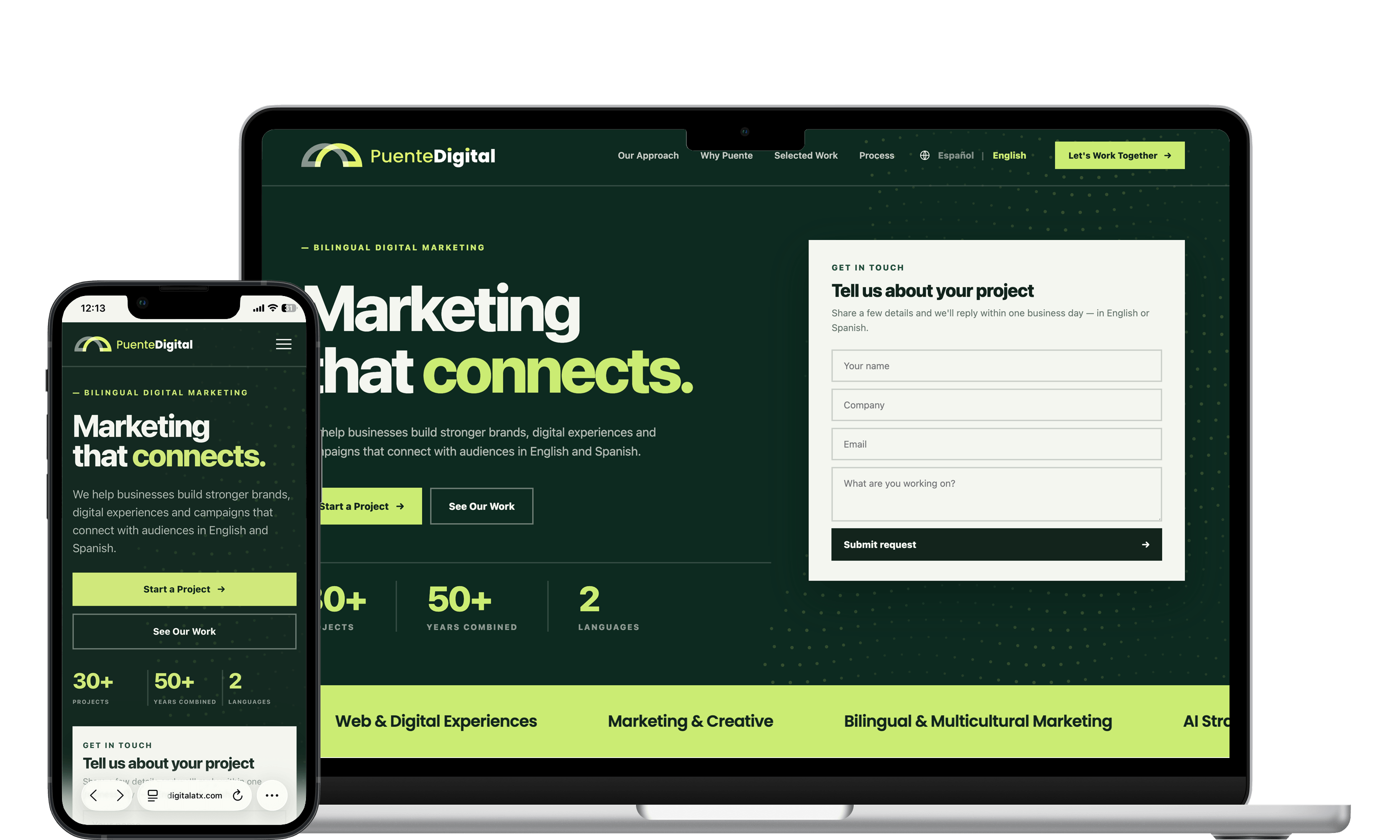
Puente Digital homepage, desktop + mobile
SITUATION
A Studio That Didn't Exist Yet
I had years of client work — brand identity for Guantanamera, product design for gotReps, marketing work for Signet, a full product build for Puente ATX, a product site for Blueprint AI — living in scattered folders and one-off deliverables, with no single place that represented it as a body of work or gave a prospective client somewhere to land. None of it shared a name, a visual identity, or even a consistent case-study format.
Almost all of that work had something in common that most design studios don't lead with: it lived at the intersection of two languages and two cultures. That became the actual positioning, not an afterthought — a studio built specifically around bilingual and bicultural work, named for the thing it does: puente, bridge.
TASK
Build the Studio the Way I'd Tell a Client To
The brief I gave myself was the same one I'd give a client: settle positioning before touching a screen, design a system that could scale to future case studies, and don't hand-wave the infrastructure. Concretely:
- A brand and voice built around bilingual positioning, not generic "we do design" language
- A homepage and case-study template that could hold work as different as a fintech rebrand and a nonprofit product build
- A real answer, not a guess, to which AI coding tool to trust for client-facing implementation work
- An actual production stack — domain, hosting, database, email, CDN — chosen and configured myself
ACTION
1. From Idea to Infrastructure
Before any design work started, the studio needed to exist as a real, running piece of infrastructure — the part of "full-stack" that design case studies usually skip past. That meant buying the domain, then deliberately choosing a stack instead of defaulting to whatever was familiar: Vercel for hosting and deploys, Supabase for the database layer, Resend for transactional email, and Cloudflare for DNS and CDN.
Owning that decision — not just the visual system on top of it — is the difference between designing a studio and running one.
2. Brand and Voice
The palette is a cream canvas with deep ink and forest-green text and a lime accent — warm and confident rather than corporate, built in Archivo. Four commitments anchor every page and every future client engagement: bilingual by design, strategy before execution, design and marketing under one roof, and built for real audiences rather than assumed ones.
Those commitments aren't a mission-statement page — they're the filter every later decision, from the case-study template to the contact form, had to pass through.
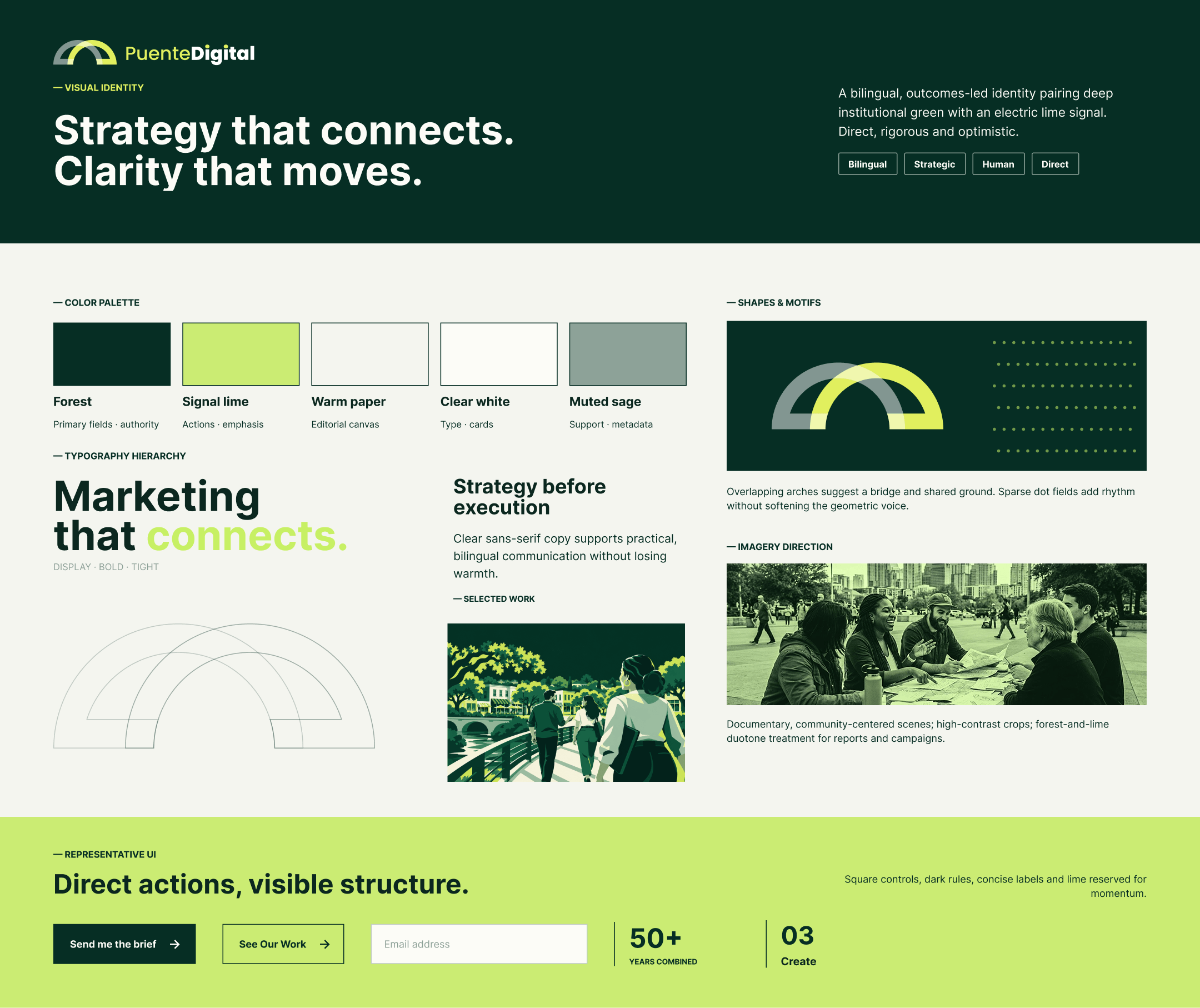
Brand system: palette, type, and the four studio commitments
3. Building It Twice: Claude Code vs. Codex
Rather than pick an AI coding tool on reputation, I built the same homepage twice — once with Claude Code, once with Codex — from the same brief and design direction. The comparison was deliberately narrow and practical: real-world performance and responsive behavior across breakpoints, not a subjective "which one felt nicer" impression.
That head-to-head is what's actually running today, not a guess I made once and moved on from. It's also the same discipline I bring to client work — verify a tool's output against a real target before trusting it in production, rather than trusting it because it's the one everyone's using.
Claude Code vs. Codex
4. One Case-Study Template, Reused Five Times
The template that holds every case study — Guantanamera, gotReps, Signet, Blueprint AI, and this one's sibling, Puente ATX — is the same underlying structure and design system every time, not a new layout improvised per client. Standardizing that early meant every deliverable, from a brand identity project to a full product build, gets shown with the same level of polish and the same Puente Digital visual language behind it.
That's a small technical decision with a real business reason behind it — a prospective client shouldn't feel like they're looking at five different agencies depending on which case study they click.
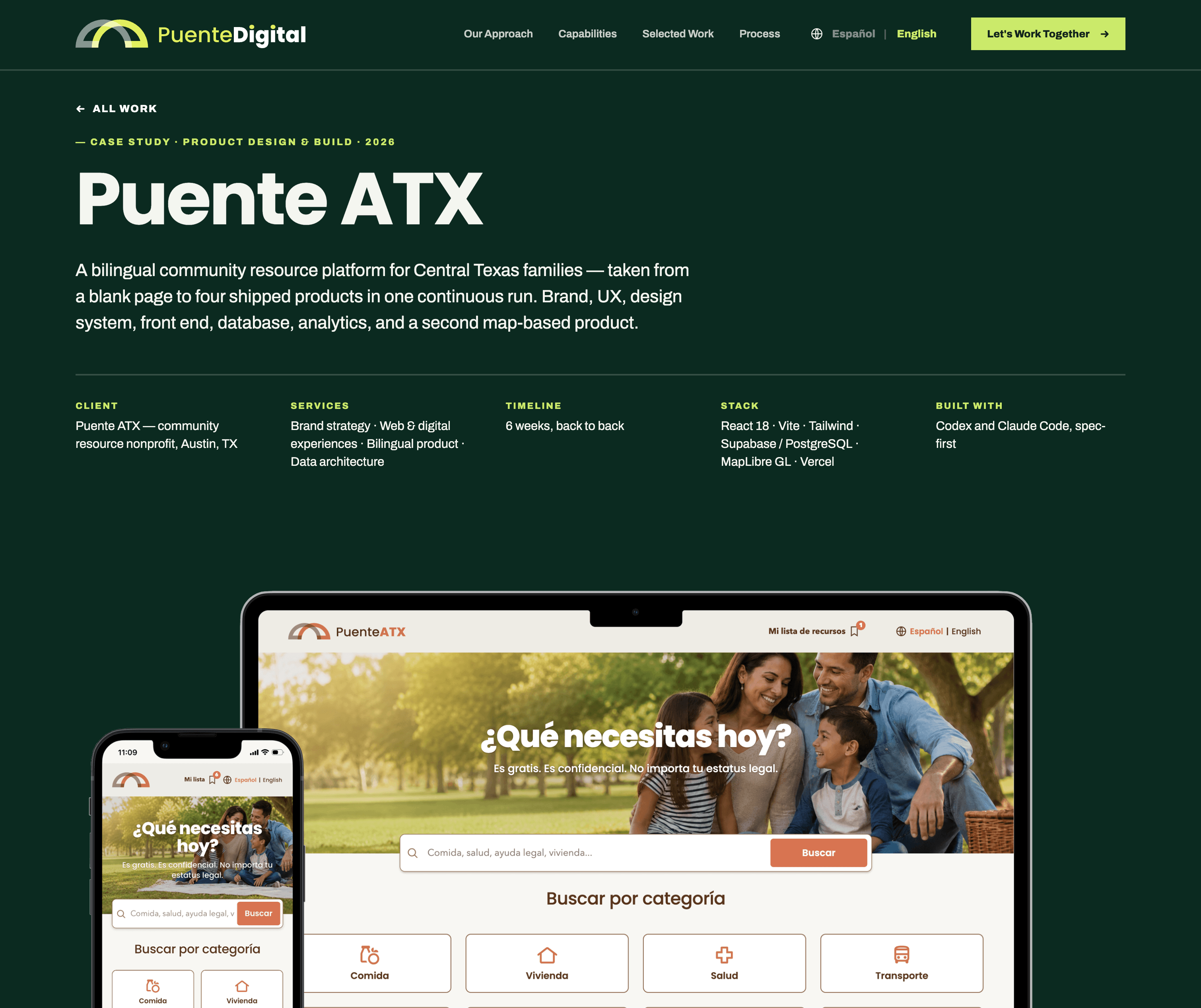
One case-study template, five real client projects
RESULT
A Studio, Not Just a Site
What's live today:
- A bilingual studio brand and site, built from a blank domain in about five weeks
- A production stack — Vercel, Supabase, Resend, and Cloudflare — chosen and wired solo
- A reusable case-study template already holding five real client projects
- A real, evidence-based comparison of two AI coding tools built on the same brief
For me personally, it answered the same question Puente ATX did, from the other side: what a solo designer can actually own end to end, from a domain purchase to a deployed stack to a working comparison of two AI coding tools, when design judgment — not headcount — is the constraint that scales.